


Tailored fat processing for regenerative procedures
Adinizer Fat Micronisation
Fat Micronisation
A regenerative approach
In the ever-evolving landscape of regenerative medicine, staying ahead of the curve is crucial for delivering the best possible care to your patients. Fat Micronisation is a cutting-edge method that takes the principles of traditional fat grafting to the next level. It involves breaking down harvested adipose tissue into micro-sized particles, increasing the surface area of the fat cells and improving their integration into target tissues. This technique opens the door to a world of regenerative possibilities.
Key Benefits of Fat Micronisation
Enhanced graft survival
Micronising fat breaks down adipose tissue into micro-sized particles, increasing the surface area and improving graft integration into target tissues. This enhances the viability of fat cells, leading to better graft survival rates compared to traditional fat grafting methods.
Natural-looking results
The micro-sized fat particles provide a smoother and more even distribution when injected, resulting in natural-looking outcomes. This is especially valuable in procedures such as facial rejuvenation, where aesthetics are of paramount importance.
Minimised invasiveness
Fat micronisation allows for smaller incisions during the injection process, reducing the invasiveness of the procedure. Patients may experience less discomfort, minimal scarring, and shorter recovery times as a result.
Versatility
Micronised fat can be used in a wide range of regenerative medicine applications, making it a versatile option for medical professionals. It can be employed for facial volume restoration, soft tissue augmentation, scar revision, and wound healing, among other procedures.
Patient satisfaction
Due to the natural and long-lasting results achievable with micronised fat, patients often report high levels of satisfaction with their outcomes. This can lead to increased patient retention and referrals.
Scar revision
Micronised fat can be employed to minimise the appearance of scars and improve tissue regeneration. This is especially beneficial for patients with scars resulting from surgery, trauma, or injury.
Reduced risk of allergic reactions
Since the graft material in fat micronisation is derived from the patient's own adipose tissue, the risk of allergic reactions is virtually eliminated. This is in contrast to synthetic fillers or implants, which may pose a higher risk of adverse reactions.
Regenerative properties
Micronised fat not only offers cosmetic benefits but also contributes to the regenerative properties of adipose tissue. It can stimulate the body's natural healing mechanisms and promote tissue regeneration in treated areas.
Shortened recovery time
Patients who undergo fat micronisation often experience quicker recovery times due to the minimally invasive nature of the procedure. This can lead to improved patient satisfaction and a faster return to their daily activities.
Customisation
Micronised fat can be finely tuned to meet the specific needs of each patient, allowing for a highly customised approach to regenerative procedures.
Advanced and Versatile
Supporting patient outcomes
In summary, fat micronisation offers medical professionals an advanced and versatile tool for achieving natural-looking, long-lasting results in regenerative medicine. Its benefits include enhanced graft survival, minimised invasiveness, and a wide range of applications, ultimately leading to improved patient satisfaction and outcomes.
Introducing Adinizer
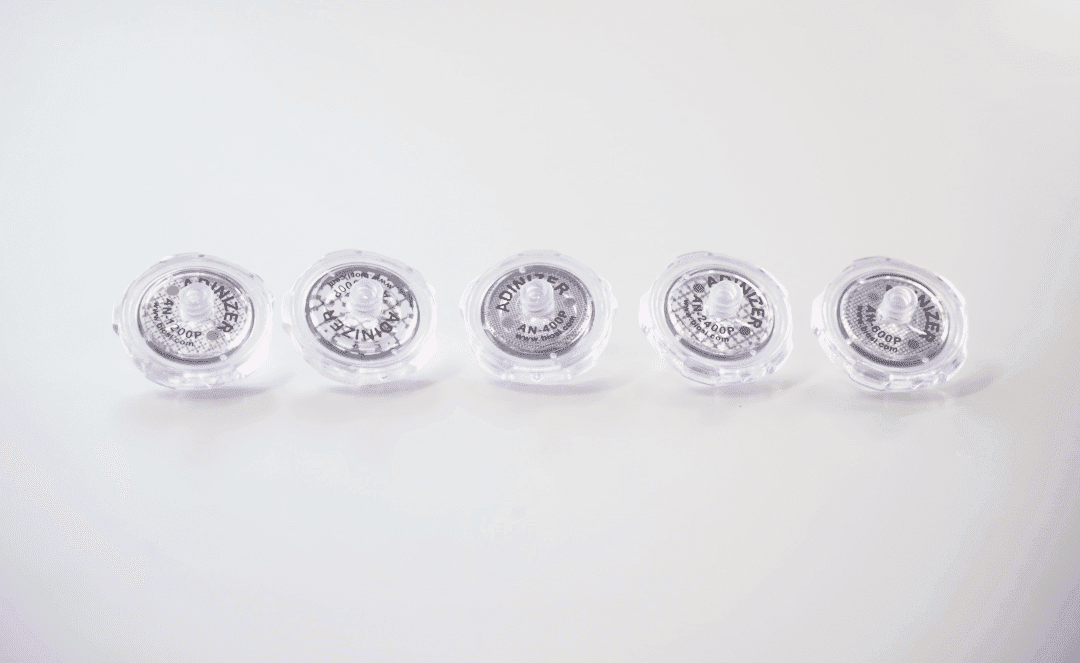
Procedure-specific fat processing
The Adinizer is the very latest development in fat micronisation, giving surgeons the opportunity to easily and effectively process harvested fat into fine, homogenised fat tissue without emulsification. The harvested fat can be homogenised into nano-fat, micro-fat or fine gel for various applications. Adinizer discs are single use and are available in 4000, 2400, 1200 and 600 microns. They are not simple filtering discs; each one has sharp bladed edges in every corner of its disc holes. Surgeons are now able to tailor their fat grafting to the procedure, instead of a one-size-fits-all approach. Wrinkles, cheeks and breasts all require different fat consistency or viscosity.
Key Features of the Adinizer Nano/Micro Fat Technology
The adipose tissue sizes of the homogenised fat through the Adinizer discs are 4000, 2400, 1200 and 600 microns.
4000 micron
The 4000 micron homogenised fat tissue is recommended for breast-volume fat grafting. The fat can be injected using a 14–18 gauge cannula.
2400 micron Micro-fat
The 2400 micron homogenised fat tissue is recommended for facial-volume fat grafting. The fat can be injected with a 14–17 gauge injection cannula.
1200 micron Nano-fat
The 1200 micron homogenised fat tissue is recommended for fine facial fat grafting. The fat can be injected using a 20-gauge injection cannula.
600 micron Fine fat gel
The 600 micron homogenised fat tissue is recommended for wrinkles and fine facial lines. The fat can be injected using a 23 or 25-gauge injection cannula.
Clinical Support
Contact our team for product information, clinical support, or to arrange a demonstration.